-
Understand your core ideology - The foundation of personal growth and self-awareness
This emphasizes the need to think philosophically and form our own independent viewpoints, which is really an advanced form of critical thinking. Many times, our inability to judge things—or our misjudgments—don't stem from the external environment, but from failing to clearly sort out our own logic. People often say you should have a mind of your own, yet in practice we often fall short. When asking ourselves deep questions like "What are my values? What are my beliefs?", we often give up right as we start thinking about them and turn to easier paths instead. However, understanding ourselves often requires experiencing the vastness of the world firsthand, or settling down to read the classics, rather than staying perpetually caught up in the rush. When we have a deep understanding of ourselves, we naturally become more confident, and our actions become more powerful.
-
Cultivate hobbies and interests - Developing personal interests helps shape a richer self
Hobbies are actually part of the flow experience. This kind of interest contains an element of "play," where the joy is spontaneous and pure. From a practical perspective, hobbies are also an effective way to connect with other people. Although everyone may be in a similar state once they start working, how an individual chooses to spend their non-working hours often reflects their distinct personality. Consciously cultivating hobbies can actually indirectly advance your career as well. Of course, cultivating an interest shouldn't be for some utilitarian purpose, but out of genuine love from the heart. Your hobbies should be the truest reflection of who you are—and sometimes, the meaning of work may simply be to support and nourish your hobbies.
-
Seek flow - Go deeper into your interests and areas of expertise
Flow refers to that focused, deeply enjoyable state we experience when we are completely immersed in an activity. It usually happens when we face a task that is both challenging and genuinely interesting to us.
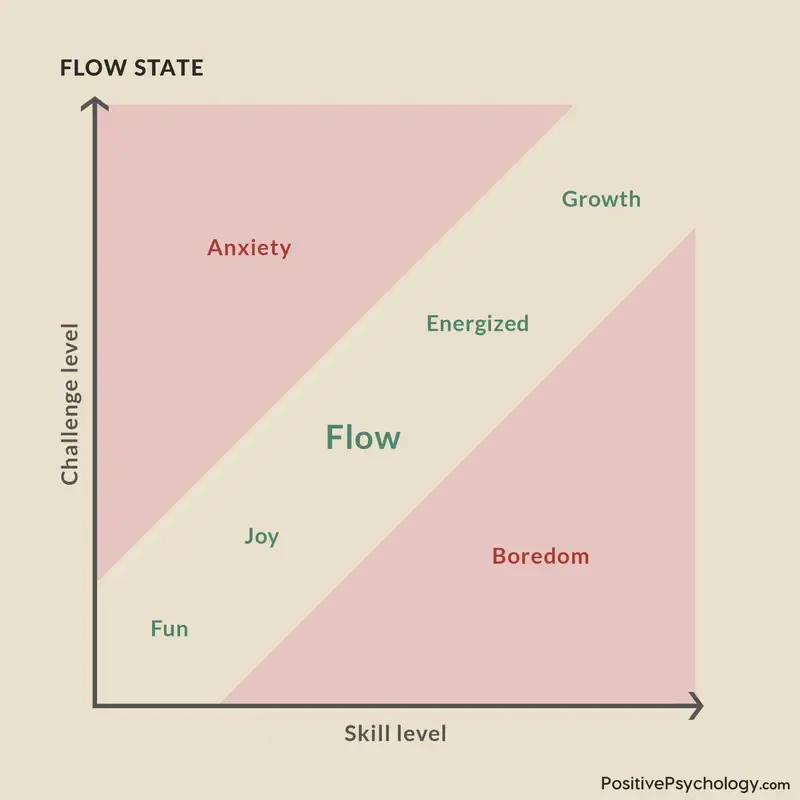
In a state of flow, our attention is completely focused on the current activity, to the point where we pay no mind to outside distractions or the passage of time. For example, when programming, I might run into a new technical concept, and when I concentrate wholeheartedly on solving it, time seems to stand still while my thinking becomes sharper and clearer. Flow isn't just a psychological experience; it also brings a deep sense of inner fulfillment. We should seek out the things that let us enter a state of flow.
-
Quantify everything - Apply rational thinking to daily life and decision-making
Our world is full of abstract and mysterious elements—like language, cognition, and emotion—that enrich our lives. However, they also sometimes make what our brains have to process too complex, leaving us unsure how to handle it or even feeling overwhelmed. We can try using mathematical thinking to deal with these obscure psychological problems, simplifying our thought process through symbols and logical reasoning. For example, when faced with two happy choices, you can score the pros and cons of each option, calculate the expected return of both choices, and make your decision from there. This process can be represented by a simple linear formula:
represents the feature value of each option (such as scores for pros and cons). is the weight of the corresponding feature, and is the base score or bias.
If this judgment process is still complex, you can use an algorithm to simplify it even further, such as flipping a coin. Essentially, this is similar to going to church on Sunday and entrusting the unknown to an external structure. By trusting mathematics and external mechanisms, we can make our decision-making process much clearer.
-
Do not multitask - Improve efficiency and focus
Growing up, I learned that multitasking—doing multiple tasks at the same time—was considered a mark of high efficiency. However, what matters is judging which things are actually suitable to do simultaneously. For example, when doing chores on the weekend, doing laundry, sweeping the floor, and listening to music at the same time is totally doable, because these activities don't place a heavy load on the brain. But when working on high-intensity tasks that require concentrated thought, such as market research or programming, focusing completely on one thing yields the greatest return. Just as reading a book takes time, tasks like these need to build up to a critical point before a breakthrough happens, such as a reorganization of the brain. If your mind isn't focused while carrying out high-intensity work, the results will actually be worse. As Google Engineering Practices points out, "Studies have shown that it can take a long time for a developer to get back into a smooth development flow after being interrupted." Even though our thinking may be exponential, I believe our actions still need to proceed linearly.
-
Optimize your daily autopilot routines - Improve efficiency and effectiveness in daily life
While avoiding falling into mindless thinking on autopilot, we should also learn to make effective use of this underlying system of the brain. By turning daily essentials—like waking up, commuting, working, and eating—into routines, we can free up more energy to focus on more important things. For example, if you have to commute every day, once you get used to the routine, you can use that time to listen to a podcast or read, enriching yourself along the way. Inevitably, however, new things will come along and disrupt these routines. For instance, when someone interrupts your work, or when moving to a new place changes your daily routine, we might instinctively feel resistance. In situations like these, keeping an open mind is crucial. We should respond flexibly to change—neither rigidly sticking to our old ways nor over-adapting to the point of sacrificing our core values. The right approach is to maintain our daily routines while also leaving room for surprises and changes so we can adjust and adapt flexibly. That way, we can preserve order in our lives while keeping our minds vibrant and adaptable.
-
Get the hardest, most important things done within 2-3 hours of waking up - Best practices for efficiency and personal management
When I reframed this from a "why" question into a purely biological science question, the answer came effortlessly. Here is an excerpt:
This is mainly related to the body's biological clock and the peak hours of brain function.
Cortisol levels: Cortisol is a hormone linked to the body's state of alertness. Research shows that for most people, cortisol levels peak within a few hours of waking up, when our alertness and attention are at their best. Therefore, the brain's cognitive function is in peak condition for handling complex and important tasks.
Psychological perspective: From a psychological standpoint, tackling important tasks in the morning reduces the likelihood of "procrastination." In the morning, the brain is clearer and psychological resilience is stronger, making it easier to focus on solving problems rather than continually putting them off as the day goes on.
Decision fatigue: As the day goes on, people gradually grow fatigued when making decisions, because the brain's decision-making capacity, like a muscle, tires from prolonged use. In the morning, the brain is fresher and decision-making capacity is at its peak, which helps with handling important tasks that require careful deliberation.
In summary, the first few hours of the morning are usually when the brain is clearest and most efficient, making them ideal for tackling tasks that are higher in difficulty and importance. Taking advantage of this window can improve work efficiency and reduce the mental burden of work.
-
Over-reflection leads to nihilism - Balancing deep thought with practical action
In machine learning, over-reflection can be compared to the concept of "overfitting." Overfitting occurs when a model learns the training data in too much detail, to the point where it even learns the noise and errors in the data rather than just the desired signal. This causes the model to perform poorly on new, unseen data, because it cannot generalize or adapt to new situations. Applying this concept to human thinking, over-reflection is like over-analyzing the details of life to the point of losing sight of broader, more universal truths. This kind of deep-dive reflection into the details can lead to doubting the universal meaning or value of anything, drifting toward nihilism. Nihilism is a philosophical stance holding that life and the universe have no clear meaning, purpose, or inherent value. Just as a good machine learning model needs to generalize to new data rather than merely fit the training data, people also need to maintain a certain level of abstraction when thinking through problems, avoiding getting trapped in endless details and self-doubt. Finding the balance point in thinking—just like finding a machine learning model that neither overfits nor underfits—is key.
-
Form a Core Support Group - Social development, learning to seek and give support in relationships
This is really a response to the fundamental nature of humans as social animals. We all have a need to connect with the outside world, yet sometimes the world feels so big that we don't know where to start. A core support group, made up of just a few people, greatly reduces our anxiety when facing the unknown. If I had to use one adjective to describe the people in this small circle, it would be "unwavering." The point of these relationships isn't just sharing moments of success and joy; even more importantly, it's that these people can support you during life's low points and help you get back on your feet. It is built on a deep level of trust. Think about it: at the major moments of your life so far, who has been around you? Who do you want to be with in the future? And as the core of this small network, we actually need to actively nurture those bonds and deepen our connections to ensure that this support network remains lasting and effective.