https://open.spotify.com/track/4bT9hPHDjm5lgGlHeUyvEe?si=2830ecbf5adc48c1
If you put every emotion in the world on a tier list by intensity, I don't think Loneliness would end up anywhere near the bottom. Although it isn't as full-bodied or raw as love or vengeance, its unpredictability makes it impossible to ignore.
Jimo (寂寞), luomo (落寞), guji (孤寂), guli (孤立), gudan (孤单)—these words all carry meanings similar to loneliness, yet each has subtle differences. Jimo emphasizes an unfulfilled longing for social or emotional connection. Luomo carries more of a sorrowful feeling of loss or abandonment. Guji makes me feel like I'm in a bamboo forest, a combination of gudan and jimo; guli leans more toward a physical or social separation from the outside world; and gudan is probably the closest word to loneliness, though it lacks that same heavy atmosphere and is more brief and fleeting. English also has a range of near-synonyms to describe these feelings: Emptiness, Desolation, Isolation, Alienation, Solitude, Estrangement, Forlornness.
What I especially want to emphasize is the distinction between Solitude and Loneliness. García's book is A Hundred Years of Solitude, not Loneliness. When the rain in Macondo relentlessly washes over the soil of Latin America, what we feel more is an understated, eternal emotion, as though the rain will never stop. When Ryuichi Sakamoto performed the piece "Solitude" in his online concert on December 11, 2022, the music we heard transcended fleeting notes and sound waves, becoming an eternity that crosses life and death. This kind of solitude is an eternal, neutral, and indestructible state. No matter what situation you find yourself in, this feeling is right there, quietly waiting to be explored. You could say that this kind of solitude is a realm in itself.
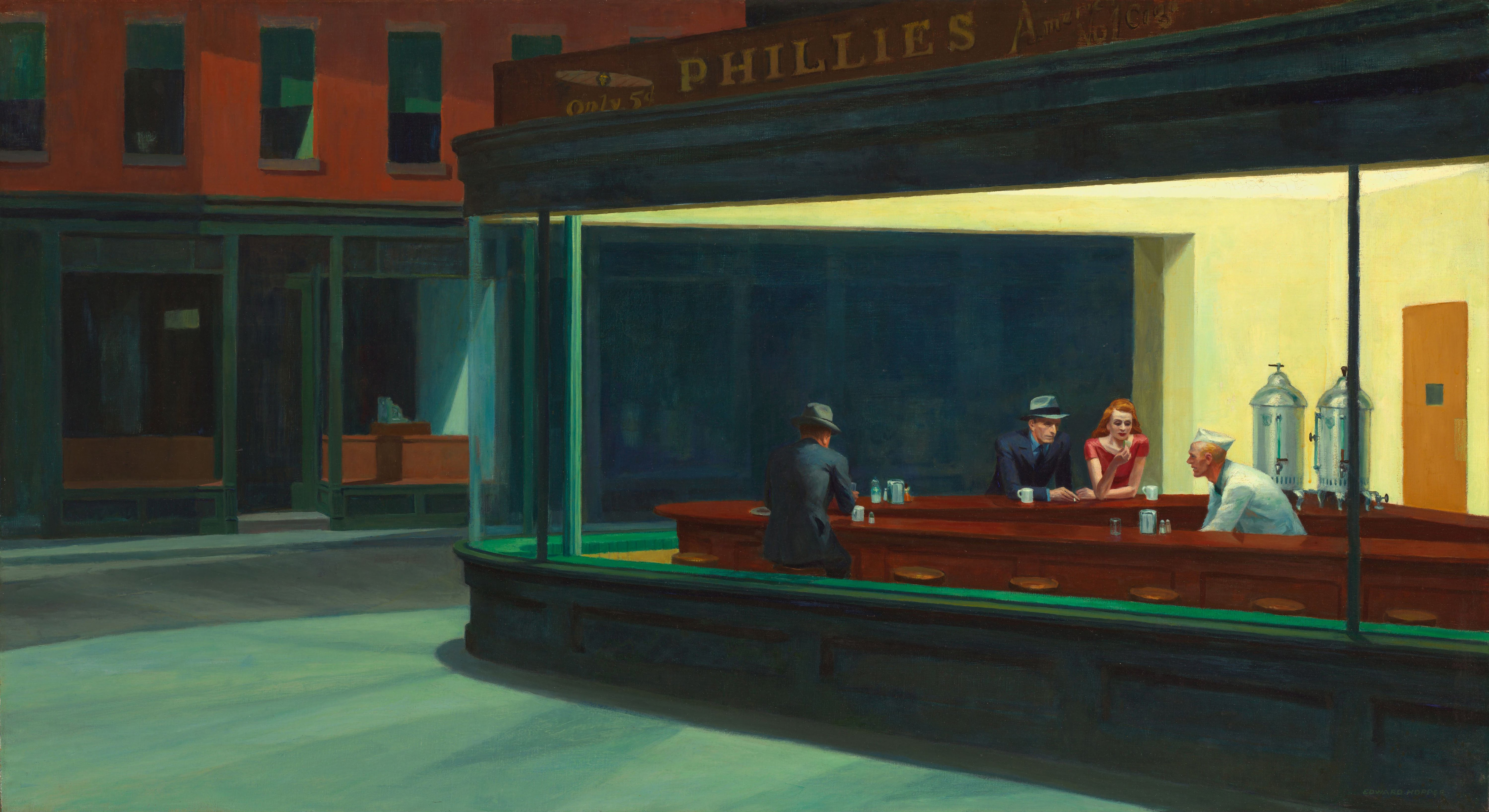
Nighthawks, Edward Hopper, 1942, oil-on-canvas
Compared to the eternity and neutrality of Solitude, Loneliness feels far more lowly and helpless. This kind of loneliness is centered on the "small self" and emotion, sometimes even seeming trivial. It involves multiple regions of the brain, including the anterior cingulate cortex, the insula, and the amygdala. These neurons continuously affect us throughout our busy daily lives, leading to a tendency to close ourselves off. Opportunities to go out and explore new things are dissolved by self-deceiving excuses, while chances for deep conversation with others are deliberately avoided. I think this isn't just escapism—it's more like our subconscious building a psychological and cognitive barrier for ourselves, perhaps out of a sense of security, a basic sense of happiness.
A lot of the time, this kind of "closing yourself off" is actually a process of building up courage: much like a neural network preparing to update its weights after a traversal. These psychological walls are actually worth taking seriously; they're like a foothold for gathering strength before a leap, enabling us to look out at the world more clearly. Yet society often takes a suppressive stance toward this kind of self-isolating behavior, as if we always have to be someone of value to others. In my view, when someone is facing Loneliness, others should offer more understanding and support. That also means having a core support group.
In the end, the key is still a cognitive shift. Notice that I haven't described loneliness as some complex, ineffable "inner" emotion; instead, through the scientific structure of the brain, I'm pointing out that loneliness is controllable. What I want to suggest is that loneliness might not be as terrifying as people imagine. Is it possible that you're actually not as lonely as you think you are? Think about the resources you currently have, then think about what you might have in the future, and live positively.
Maybe in the end, all you need to do is open your hands and reach toward that blue sky.