I. Experience
I often experience a sense of transcendence (transcendental experience).
Fragment 1: After School
Stepping out of the low corrugated building where you could barely tell one floor from the next, I heard the soft, yielding scuff of my Nike sneakers—hard to say whether they were ugly or good-looking—against the green plastic turf. Crossing the latticed walkway that looked like a grape arbor, I came out onto the rubber basketball court. At the far end of the main sports field—seemingly boundless, though actually quite small—stood the lab building bathed in the setting sun, vines already blanketing the small auditorium. To the right, the facade of the administration building was so plain it was barely noticeable, its pale gray seeming to melt into the blue sky, just like the dean of students' face. Classmates walked away from me toward the school gate in twos and threes; their blue-and-white school uniforms erased all individuality, leaving only faint bursts of laughter and chatter. Was I alone? I can't remember. Yet in that moment, as ordinary as a moment could possibly be, a sense of transcendence enveloped me. Following the sunlight glinting off the golden school motto mounted on the side of the building, my gaze rose into the sky, and the outlines of the various buildings grew thicker and heavier along a slope of y=1/2x. The next second, those lines morphed into the forms of Boccioni's Those Who Go. I felt as if I could look down over Beihaibei and see myself standing in a daze on the field, my whole body filled with a mingling of cold and warmth.
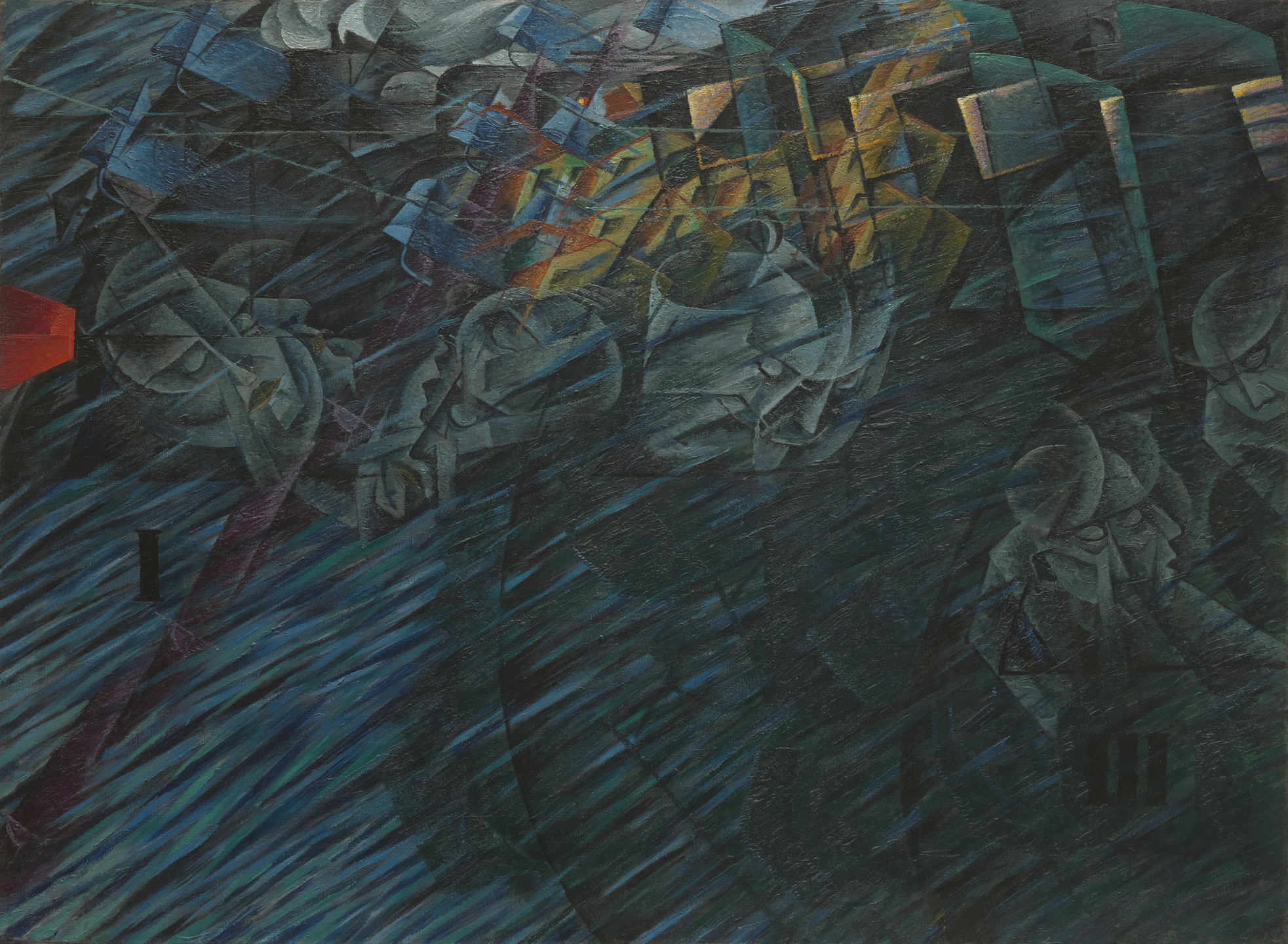
Umberto Boccioni, States of Mind II: Those Who Go, 1911
Fragment 2: The Cemetery
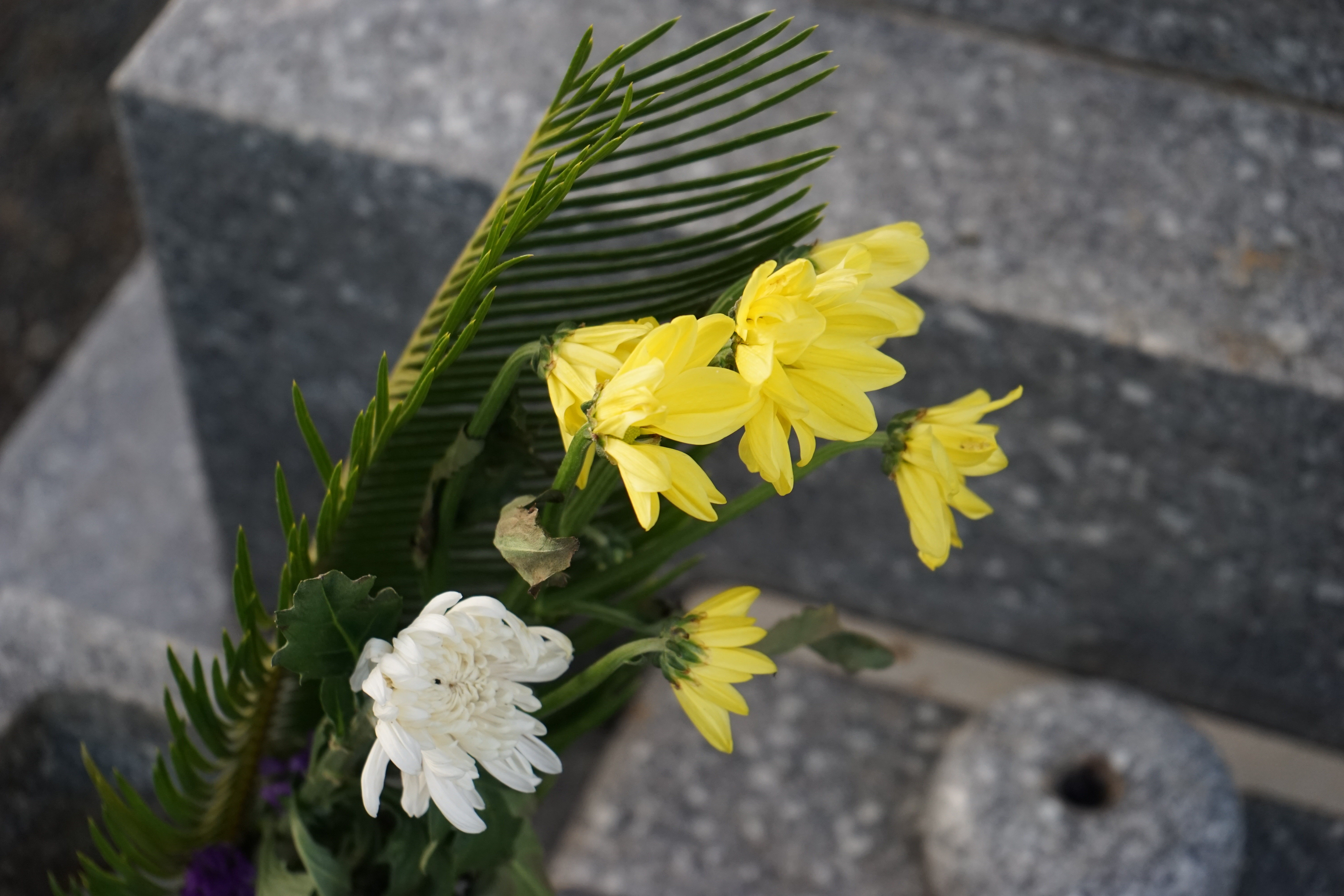
The asphalt road beneath my feet gave way to fine gravel. Flanking both sides were lush pine trees, their spiraling trunks rising like the Elder Wand, yet the gaps between their needles held no magic, only a clean, dead stillness. Uneven foliage made some of the plants look incomplete, like hollowed-out garden rocks, able only to huddle together like that. As I kept walking, an ancestral hall appeared in the middle of the path. It was made of ten slender concrete pillars that converged five or six meters up into the shape of a crown. The paint had peeled away from the surface, leaving blackened stains, one of which formed the cross of the Crucifixion; directly beneath it sat an obscure, heavily weathered tombstone. Late October autumn and the ardent evening wind scattered my thoughts; I quickened my pace and walked up to his grave. Before me was a muddy path with two low steps, its brownish-gray surface pale with an aged whiteness. Nearby stood neatly trimmed oval shrubs, echoing the square stone tablets around them. His headstone was made of marble, smooth on the surface; the gray, white, and black that usually felt noisy now looked remarkably composed. Several bunches of plants were set in front of the stone, the most prominent being yellow chrysanthemums with delicate petals. I took out my camera to capture it. In contrast, wildly overgrown stems and rotting stalks barely stayed upright, their leaves sparse. That chrysanthemum surely wouldn't last long either. Though my feet were planted on the earth, my mind seemed to drift into a trance. The universe shrank, leaving only him and me conversing in a soundless space. I pulled a cigarette case from inside my jacket and handed him one; after lighting it, he walked away without looking back.
Fragment 3: The Back Seat
The moment the car door shut, a private space took shape. I shook out my long, slim jacket, trying to get the fabric to hang at its best. Every now and then I glanced over at her, hoping to catch her fragile posture nestled in the leather seat. Her pinned-up hair blocked the left window, keeping me from seeing the view she was watching, so I turned my head back toward my own side. Drizzle streaked across the window, breaking into dashes as the car accelerated, like chalk line segments drawn by a professor on a blackboard. Through the curved glass, bare tree trunks loomed and faded against the hazy night sky, exposing the houses behind them. Resting my hand against the window, a New England autumn chill spread across my palm. I didn't pull my hand back; instead, I pressed into the cold to feel it fully. I tried to listen for her breathing, yet gradually I couldn't even hear my own. The car and the road fell into relative stillness, and the dim yellow glow of spotlights spilled into the cabin. She buried herself behind her scarf, and our shadows intertwined.
II. Retrieval
A sense of transcendence is an instantaneous experience that warps time and space. Accompanied by a pause in time, it may be the truest experience of Δt→∞. I believe the essence of this feeling occurs at time t, but because we are immersed in it at that moment, we cannot describe or perceive it normally. So by t+1, we have actually returned to reality, and it is then that we begin to summarize and learn from what we just experienced at time t, trying to explain that uncanny experience with ordinary intuition. This might be a kind of PCA (Principal Component Analysis) or some form of RNN (Recurrent Neural Network). The other dimension is space. When experiencing a sense of transcendence, you and the objects around you seem to be abstracted into celestial bodies of greater mass. A powerful gravitational pull exists between these objects: not only are you drawn toward other things, you exert a pull on them as well. Could it be that the more attention and emotion we invest in a particular object, the more likely we are to be affected by it during a transcendental moment? More interestingly, this sense of transcendence can appear out of nowhere in any situation, without any warning and without needing any stimulus. That uncertainty actually lends it a kind of freshness.
A sense of transcendence is an expansion of the senses, often accompanied by an altered perception of visual elements (such as light, color, and form), perceptions that sometimes take on geometric or abstract qualities. It is also a detachment of the spirit: during the experience, I feel my self uncouple from physical reality and enter a transcendent mental state. And it is a mingling of opposites. In a transcendental state, I often experience complex, blended emotions—cold and warmth, serenity and chaos, isolation without loneliness. Even though I was alone for most of these fragments, I didn't feel lonely; instead, I felt a certain connection to my surroundings or to some unseen presence. Perhaps this is closer to a collective unconscious, or a heightened sensitivity of the human mind responding to external phenomena.
Connection means the disappearance of the self. The apathy and spiritual emptiness triggered by suppressing subjective consciousness are often compensated for by watching other people's experiences, such as vlogs. These regularly updated experiences start to feel as if they were your own. Yet the experience inside a video is incomplete. A vlog's visuals and storyline may be flat and straightforward, whereas the world our eyes capture has depth of field, perspective, and dimensionality. Most crucially, a video offers only a single narrative perspective—it is curated down to highlights, and it is biased. Our inner struggle lies in the fact that we neither believe nor want to admit that this sense of transcendence is illusory; it is like muttering to ourselves that struggling inside this narrow crack has meaning.
The shattering of a sense of transcendence often follows certain patterns. At the exact instant a movie rolls its end credits, a game displays an ornate "The End," or we close the cover of a novel, what we experience is a sense of transcendence. In that moment, it feels as though one foot is planted in the physical world while the other still lingers in virtual reality, our whole self caught on the threshold between the two worlds. As if, were we to glance back, the characters and worlds inside those mediums would still keep moving according to their own laws. All silent, faded memories surge into our minds at once, tightly bound to neural signals. A sensation of our shadow overlapping with our id makes us momentarily forget Earth's gravity, only to be yanked sharply back by the reality right in front of us: the dispersing crowd, the pressure of headphones, the weight of the book. You'll be surprised to find that in that moment you notice details you usually overlook, like a newborn exploring this world for the very first time.
Having come to know that this sense of transcendence exists, I look forward all the more to the next time such a singular experience arrives.