I don't think life itself necessarily needs to find some ultimate "meaning." I feel like this is a lot like Camus's existentialism: a rejection of meaning grounded in absolute truth. At the same time, I think what matters is "living" itself. This comes from Nietzsche's concept of the Übermensch—the idea that an individual transcends traditional morality and values to give life meaning on their own terms. Like him, I reject tradition and moral conventions, and I champion individual creativity and self-actualization. I think when we say someone has great vitality, it must be because we've picked up on that exact mindset in them. So this dynamic between the observed (the person with vitality) and the observer (us) requires two mutually reinforcing elements: first, the observed person's personal agency; second, that the observed and the observer are on the same wavelength. By "on the same wavelength," I mean similar perception and empathy—I won't go into that here. This post focuses on personal agency.
Personal agency describes a sense of strength. This sense of strength must come from the inside out—it isn't bestowed upon you from the outside. It makes me think of a medieval knighting ceremony.
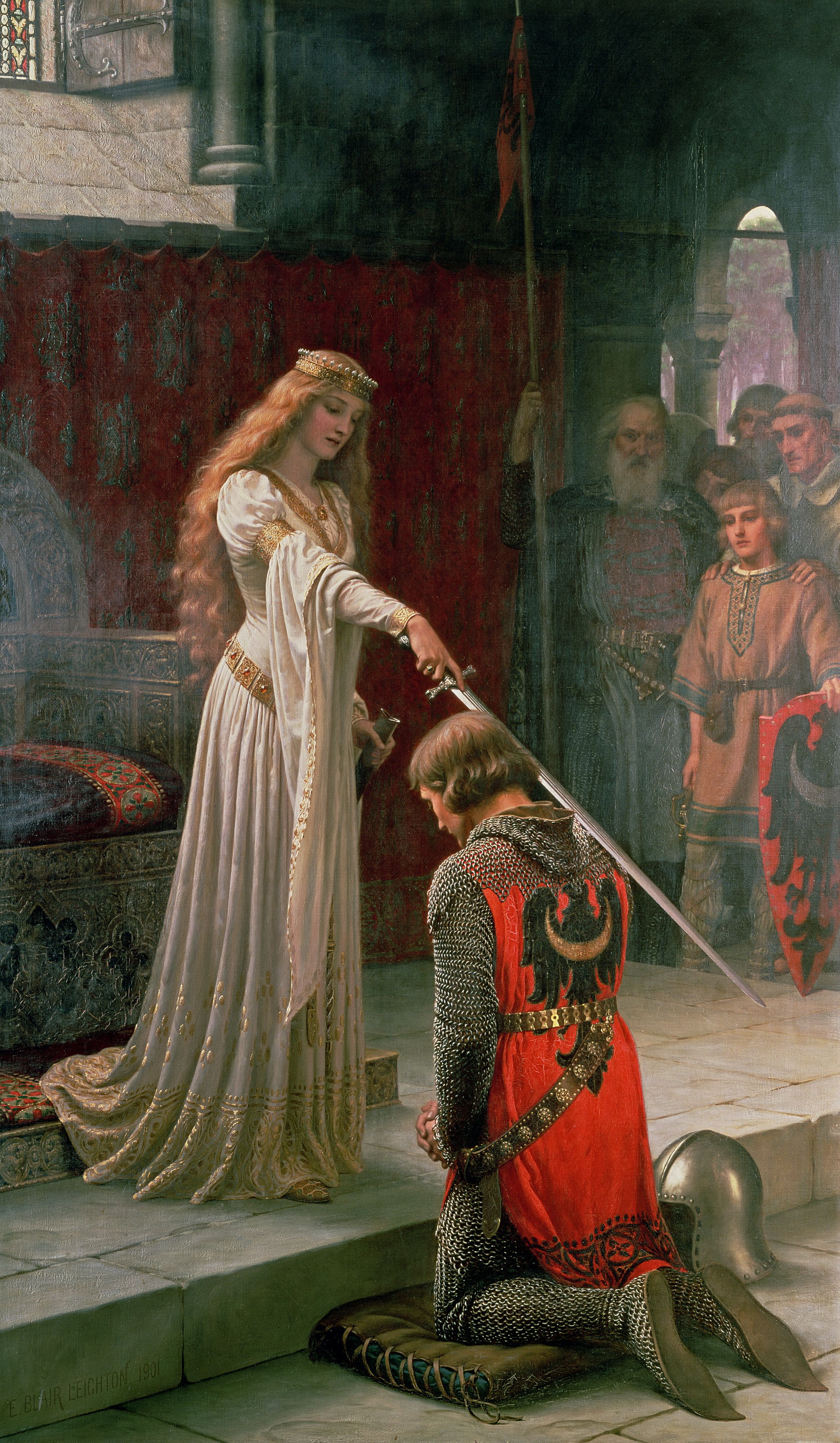
Edmund Leighton: The Accolade (1901, oil on canvas)
When the iron sword sweeps past their head and comes to rest on the shoulder of their finely woven chainmail, the incomparable, sacred power the knight feels is definitely not charity handed down by the Pope or the Virgin Mary. In fact, I think in that moment, if the sword tilted just slightly, their head would be separated from their body—so what they ought to feel is danger and vulnerability, sensations completely opposite to strength. So for the knight kneeling on one knee, that sense of strength comes from their own pursuit of honor and pride within; it is self-bestowed. Of course, in that historical context, this kind of strength could give rise to fortitude and loyalty, just as easily as stubbornness and corruption—which is why closely tied to strength is control. This mental power originates in the brain: if someone can masterfully use their mind to control their body, then this "tamed strength" will bring them boundless energy—what's known as the unity of knowledge and action.
This sense of strength shows up on the outside—it's what we commonly call someone's spirit and vigor. If we say someone is high-energy and lively, they probably have strength inside. I say "probably" here because some people come across as very energetic, while on the inside they're actually quite empty.
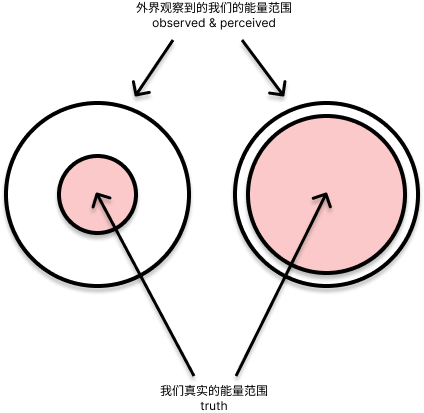
To illustrate this with a diagram, the kind of person I'm describing is the circle on the right: their inner excitement and passion match their outward appearance closely. The first impression they leave is usually genuine, flesh-and-blood, strong-willed, and decisive. The circle on the left has ideas of its own too, but usually has a hard time holding a fixed shape, and its energy fluctuates wildly. In fact, because they have so little energy of their own, they end up draining energy from others. For us to become energetic, positive people, we not only need to enrich our inner world, we also need to pass that energy on to others. In my view, we need a strong physique.
Inner strength translates into demands on the physical body. This isn't a fitness fanatic's obsession with lifting heavier weights—it's consciously appreciating the beauty of your own body, holding a standard for physical health, and training toward it. If someone is obese, they clearly lack control over their own body, and their mental world is bound to be listless. Nobody like fat people. By the same token, people who chase a skinny figure aren't giving themselves strength either. Physiologically speaking, a frail body means reduced muscle mass, inadequate nutrition, and an impaired immune system. In truth, that weakness strips away so many possibilities for expressing life. The reason being an athlete can even be a profession is actually driven by our longing to see what's possible when human physical and mental strength work together. Or take dance, another perfect display of vitality. The traces a dancer leaves across the stage declare to us, "I am still alive"—it's a kind of poetry of life. Interestingly, among straight people, a lot of guys aren't into frail, skinny girls, and a lot of girls aren't into bulky, hulking guys either (note: "a lot" here is from my own incomplete observation—for humanity as a whole, it's the middle of the bell curve with a tiny sample size). So what we humans are drawn to is really a state of health. If I had to sum it up in a phrase, it would be a "gender-neutral athletic build," like the statue of David. If we trust human nature itself, then humanity's universal consensus on beauty can offer us guidance too. So in the saying "life lies in movement," it's much better to understand "movement" as "being active" rather than "doing exercise." Who can remain still for long, and through movement gradually bring forth life?
Coming back to myself, I feel like the body I have right now isn't the body a 25-year-old ought to have. A lot of friends my age around me are already seeing issues with their physical functions. That's a warning sign. While we're all chasing progress in our careers and families (which are expressions of vitality too), the most critical vessel of life itself should grow right alongside them. If software development is brainwork that needs a powerful CPU, then it also needs a matching GPU (eyes), monitor (face), other I/O devices (limbs), cables (blood vessels), motherboard (muscles), and so on to back it up. I've made up my mind to upgrade my body's components.
I love my life, and I love individuals who are full of vitality. I want to fill myself with energy, and then collide with the people around me. The process of passing energy back and forth is what forms the meaning of our lives.
